
Most policies are right. A tool that only earns its keep on the policy with a gap in the tower would be a tool for one renewal in twenty. The other nineteen still have to be checked, summarised for the client and delivered on time — and a clean check should take minutes, not an afternoon.
This post follows an illustrative commercial auto renewal where nothing fails: 48 of 48 checks match. What is left is the comparison with the expiring, the delivery writer’s summary and the account executive’s signature Illustrative.
| Insured | Cobaltline Freight, Inc. — a regional trucking company (illustrative) |
|---|---|
| Line | Commercial auto, renewal |
| Proofing | 48 of 48 checks match — nothing to raise |
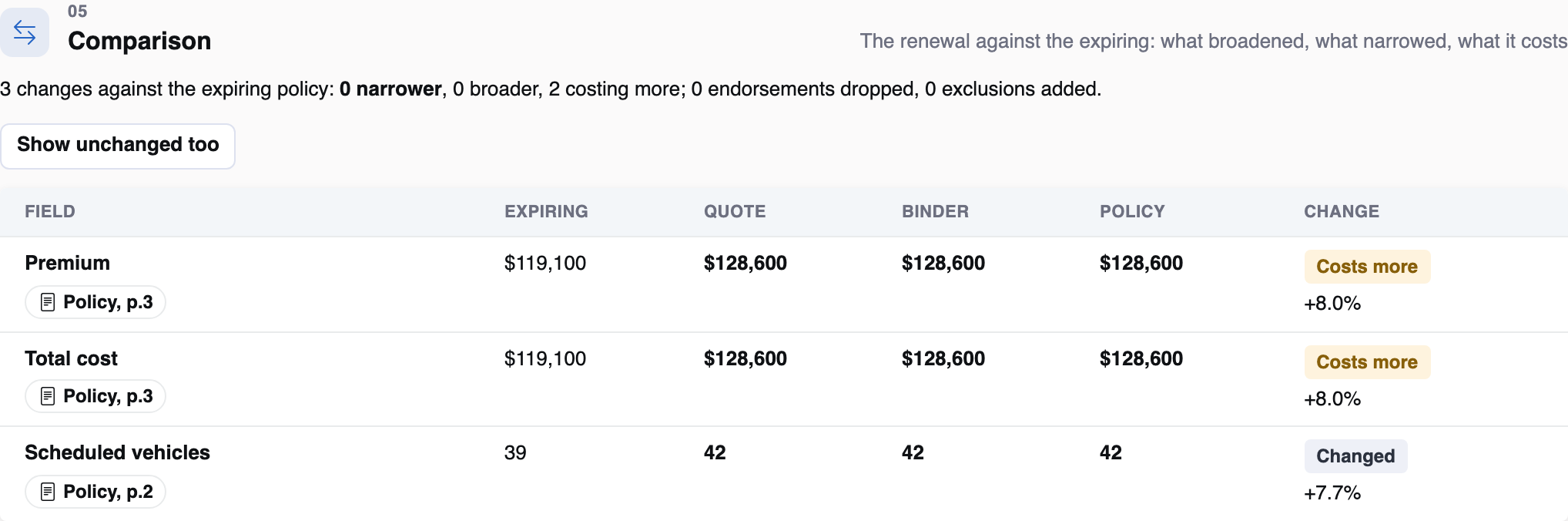
| Renewal changes | Premium $119,100 → $128,600 (+8.0%); scheduled vehicles 39 → 42; nothing narrower |
| Agents involved | Proofing checker, renewal comparison, client delivery writer, supervisor |
| Decision | Deliver the policy to the client — the account executive signs |
| Outcome | Ready to deliver the day the policy arrives |
The short path
With nothing unresolved, the stage machine allows Proofed → Ready to deliver directly, skipping With carrier. The controls still run: an 8% premium increase is under the 25% control, and nothing narrowed, so no warning asks the summary to explain anything.
Step by step
The auto taxonomy: combined single limit, UM/UIM, medical payments, comprehensive and collision deductibles, hired and non-owned auto, scheduled vehicles, premium and commission.
48 of 48 checks match, including both binder subjectivities — the driver list with MVRs and the signed UM/UIM selection — shown as received and satisfied.
Three changes: premium and total cost up 8%, three more scheduled vehicles. None narrower.
“Enclosed is your commercial auto policy … We have checked it against what was agreed. At renewal 3 items changed, none of them narrowing your cover.” With the model off, this is the engines’ own wording and the screen says so.
Adds an optional note to the file and presses Sign and deliver to the client. The signature is written to the decision record.
What the screens show

The label on the summary — To the client · from the engines — says who wrote it. When the model is on, the delivery writer rewrites the paragraph in plain words, held to the same facts.
| Agent | What it prepared | What it cites | Who decides |
|---|---|---|---|
| Client delivery writer | The client summary and what changed | The checked policy, the renewal changes | Account executive |
| Supervisor | No control fired | The check’s counts | — |
| Section | Hit | Outcome |
|---|---|---|
| Proofing control | Every control | pass |
| Delivery | Deliver the policy to the client — prepared for the account executive | proceed |
For the account team
Clean policies are fast: read the summary, sign, done.
For broker IT
The same pipeline runs on every check; a clean one simply prepares only the delivery.
For practice leadership
Time to client delivery on clean renewals is one of the numbers worth tracking from the product’s own record.
Questions we get asked
Does a clean check skip anything?
No. Every check runs; there is simply nothing to raise, so the only prepared decision is the delivery.
Keep reading

Workers' comp: broader cover, and a policy that never arrived
Employers liability doubled and the mod fell. Forty days after inception, the client holds only the binder.
Read article
Where InsightProofing sits in the broker suite
Placement hands it the binder; Xtract reads the PDFs; Pulse knows the client; Advocate inherits the policy.
Read article
The first ninety days, and how to measure it
One team, one renewal month, every action at ask first.
Read article