- contact@verticalserve.com
- Every policy checked against what was agreed · part of the Insight broker suite
InsightProofing · The AI-first policy-checking workbench
Every policy checked by agents. Every difference cited to the page.
Before a binder, policy or endorsement reaches your client, InsightProofing reads it against what was quoted, bound and expiring. The engines decide pass or fail; nine agents explain each difference and prepare the correction and the client summary for a person to sign.
8policies in the demo book, across 7 lines
55checks on one general liability renewal
9agents, every action capped at ask first
8proofing controls in Rules Studio
Figures from the illustrative demo book: invented brokerage, carriers, insureds and documents.

Proof, not promises
Three screens from the demo book, as they are
An invented brokerage is checking eight invented policies. This is what InsightProofing put in front of the account team without being asked.


The problem
A policy that reaches the client unchecked is the broker’s E&O exposure
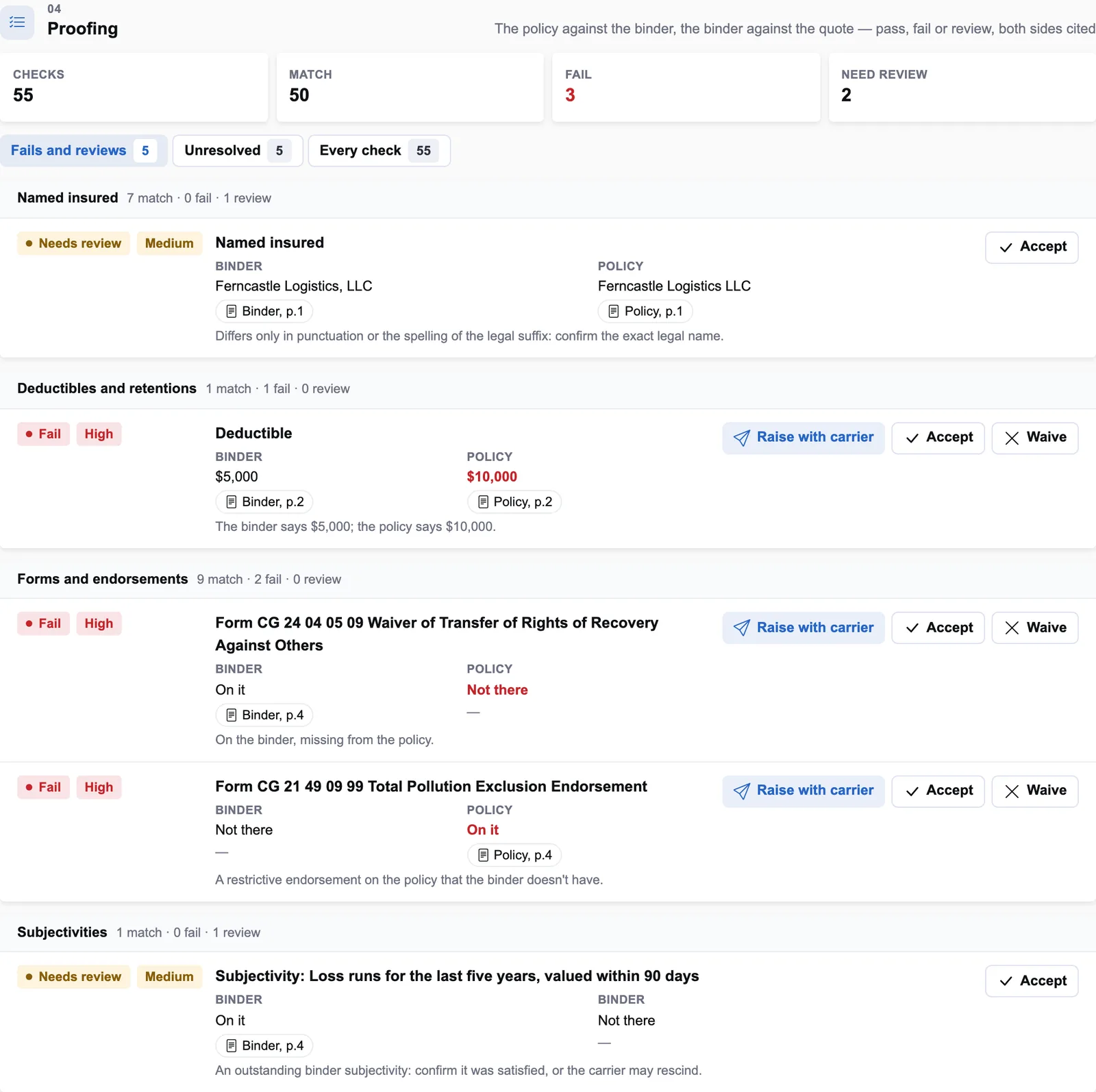
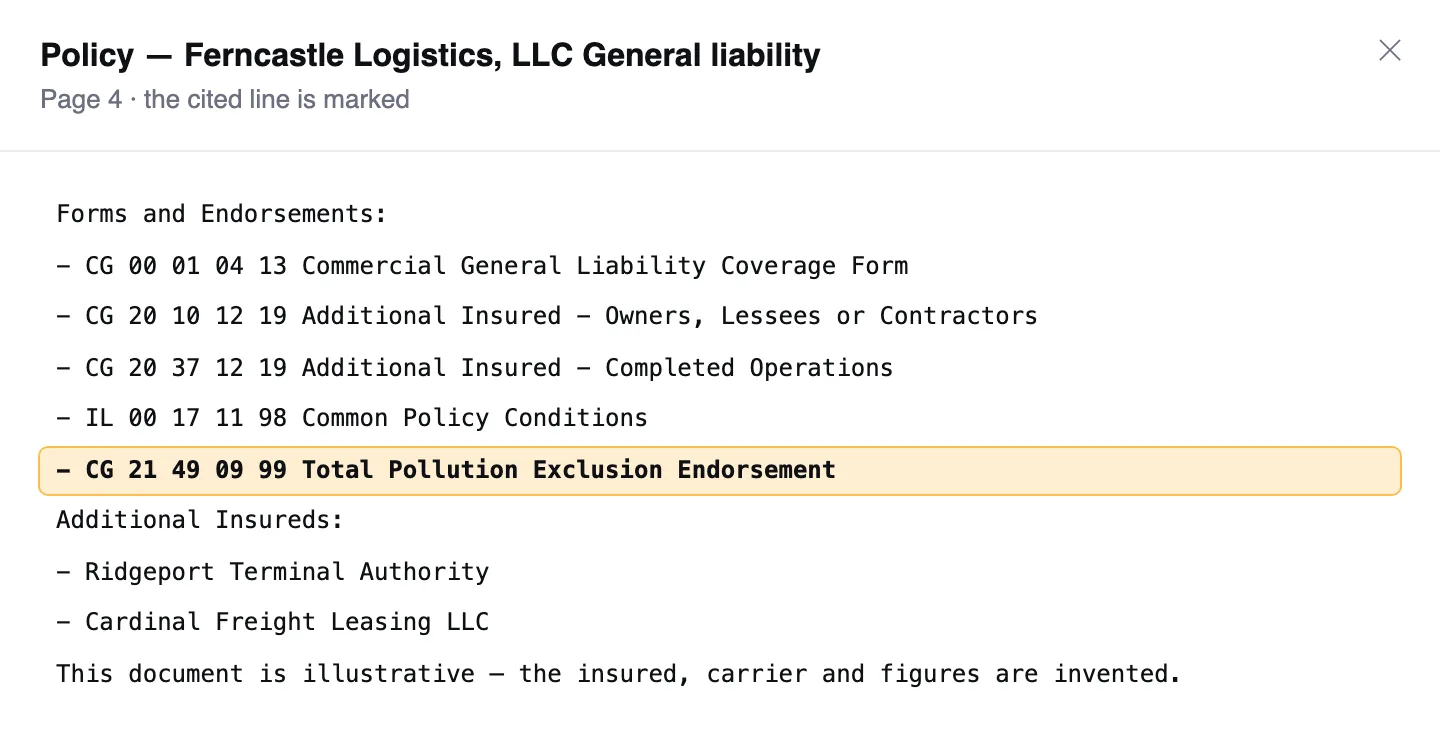
The binder said a $5,000 deductible; the policy says $10,000. An endorsement the client paid for is missing. Each is a line on page four, found by someone reading two documents side by side — or by the client, after a loss.
E&O
Differences found after a loss
The time to catch a dropped endorsement or a narrowed sublimit is before delivery. After a claim, it is an errors-and-omissions matter.
Volume
Hundreds of policies at 1/1
Renewals bunch up. Checking each one line by line against three other documents does not scale with the season.
Wording
Every carrier labels it differently
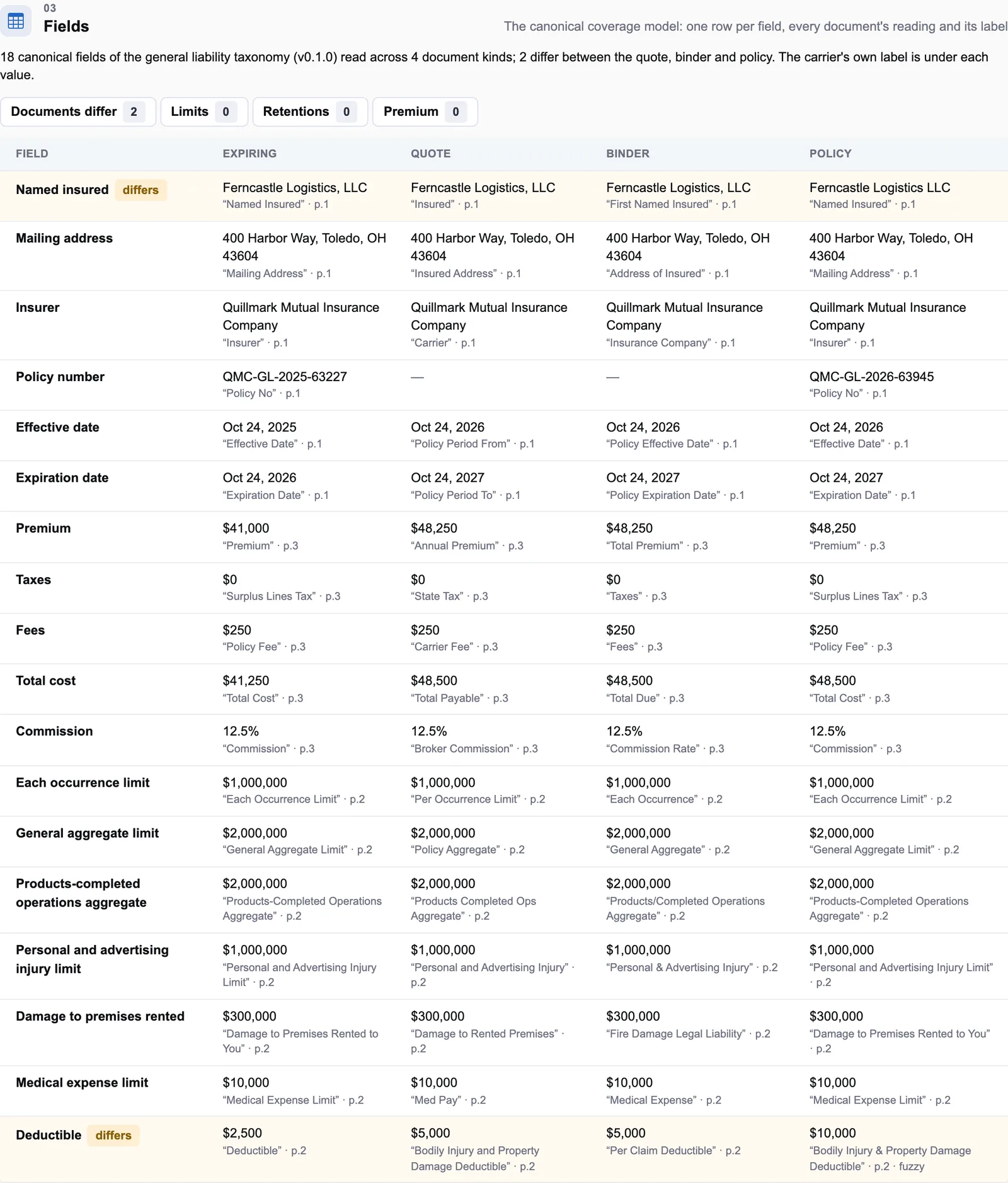
“Per Occ Limit” on the quote, “Each Occurrence” on the binder, “Each Occurrence Limit” on the policy — the same field, three ways.
Follow-up
Corrections that go quiet
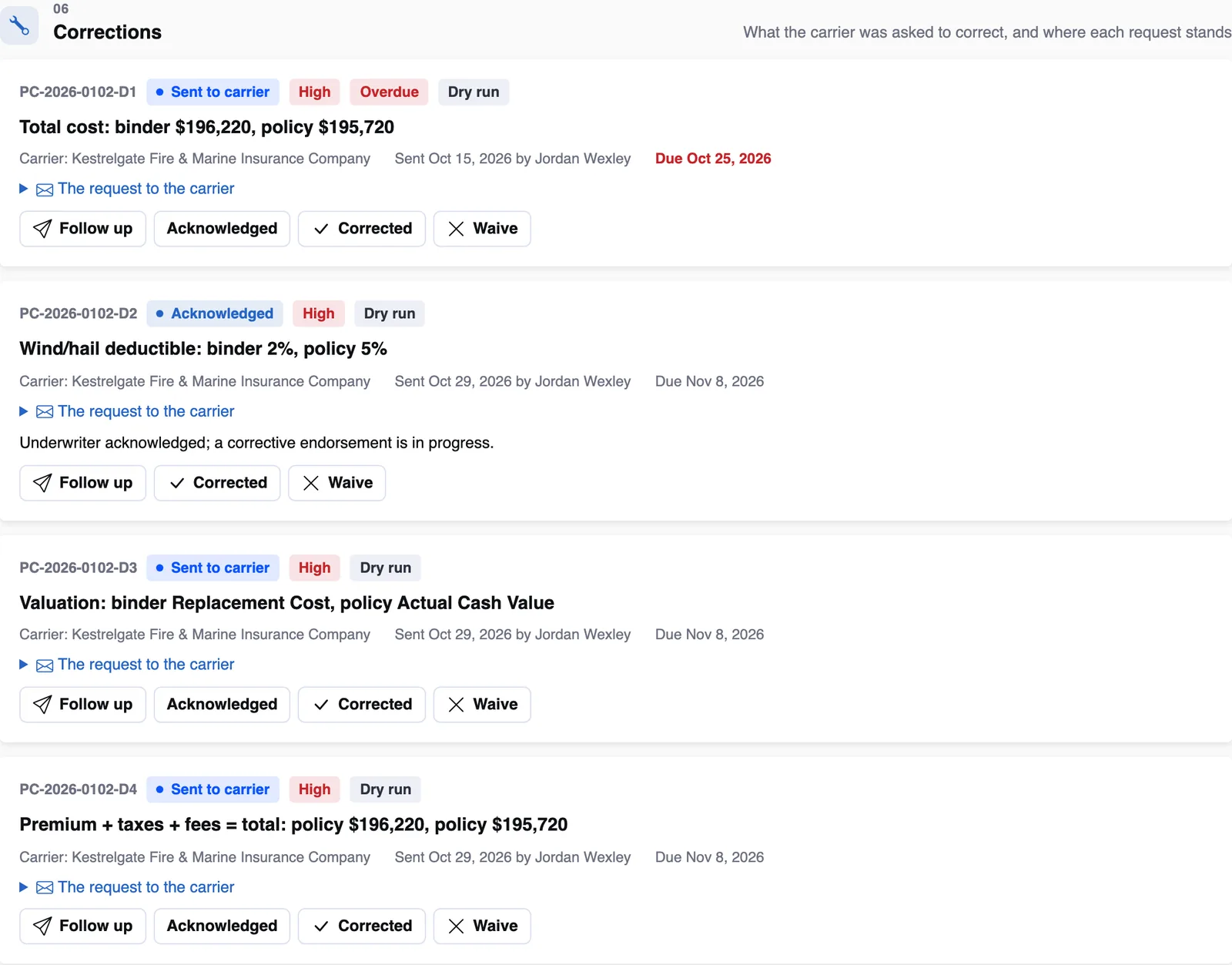
A correction asked of the carrier in an e-mail has no due date and no owner, and the policy sits undelivered while it waits.
The product
Read, proof, compare, correct, deliver — in one workbench
Every document, every field and every difference on one page per policy.
Every document read
Expiring, quote, binder, policy and endorsements, read page by page into canonical fields.
Learn moreOne field, any wording
‘Per Occ Limit’ and ‘Each Occurrence’ are the same field; a person confirms close matches.
Learn moreProofing
Policy against binder, binder against quote, field by field. The engine decides pass or fail.
Learn moreRenewal comparison
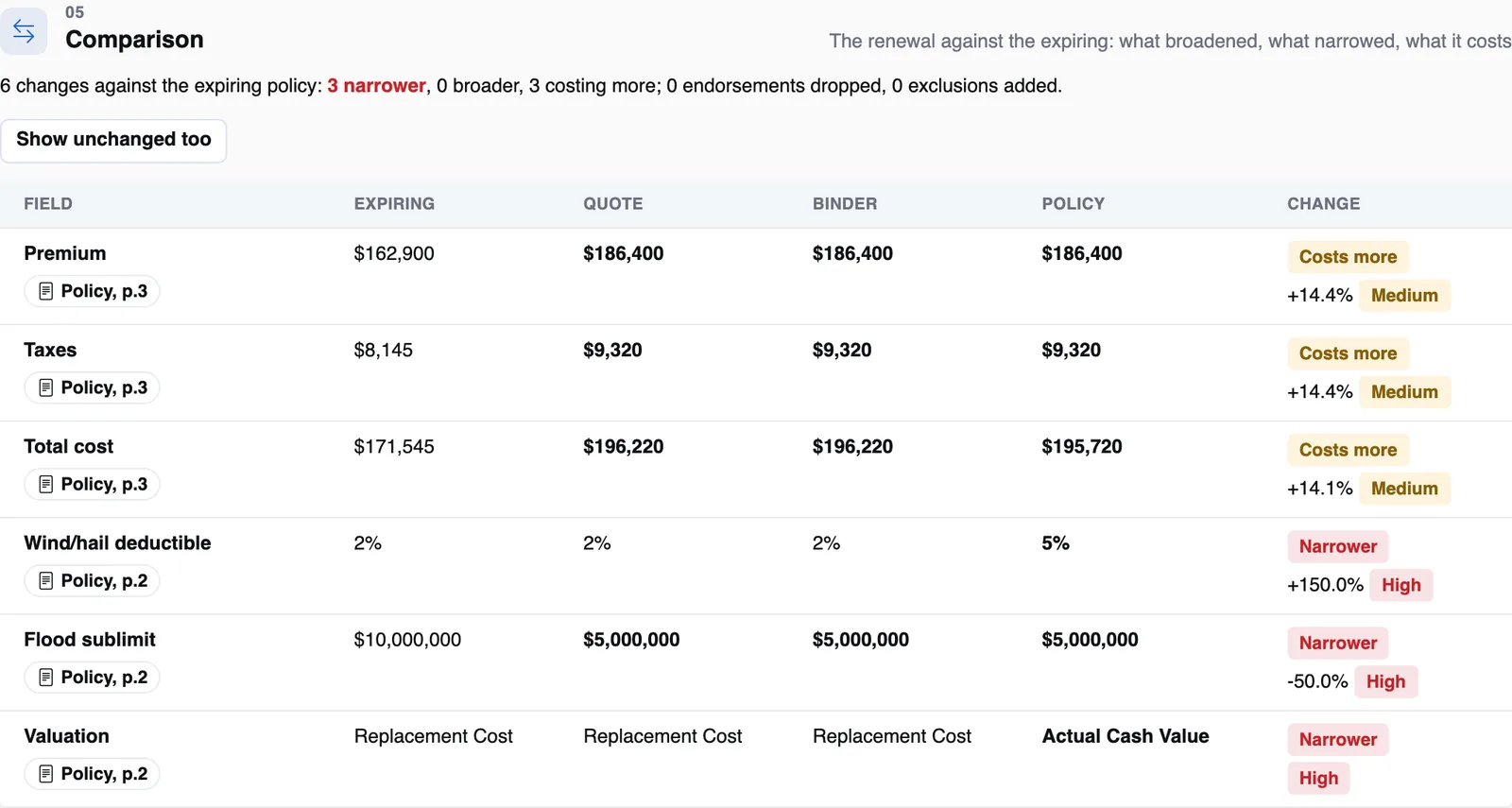
Every change from the expiring policy, read as broader, narrower or costlier.
Learn moreTowers & underlying
Layers that attach without gaps, and a schedule of underlying that matches what was bound.
Learn moreCarrier corrections
Failures raised as tracked requests with owners and due dates; overdue ones surface.
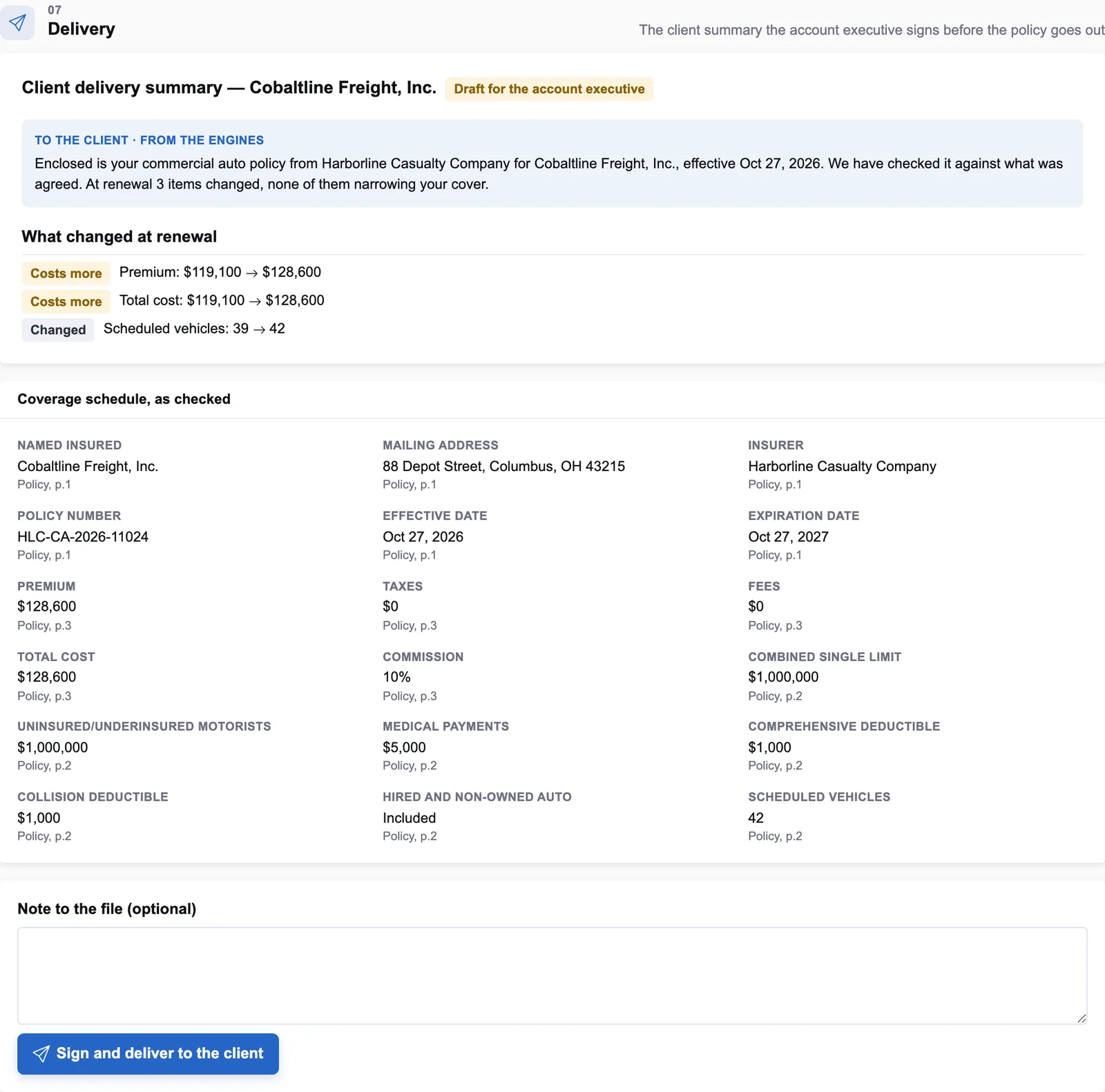
Learn moreClient delivery
A summary of what changed and what was corrected, signed by the account executive.
Learn moreRules Studio
Proofing controls a practice leader can read, test on a real check and publish.
Learn more
How a difference is found
From the documents to a signed delivery
Press Check and nine agents run in order. Every pass, fail and change comes from the engines; every step after reading is something you can open and check.
1
Read
Each document into the canonical model, every value with its page and the carrier’s label.
2
Proof
Policy against binder, binder against quote, plus term, premium arithmetic and the tower.
3
Compare
The renewal against the expiring: broader, narrower or costlier.
4AI
Agents reason
Nine agents explain each result, cite both pages and draft.
5AI
Prepared
Correction requests, label confirmations and the client summary — never sent.
6
A person decides
Raise, waive with a reason, or sign and deliver. A high-severity failure blocks delivery.
Model switched off or failing: the engines’ checks stand on their own, and every prepared decision says it reasoned by rules.
Every answer, waiver and sign-off is signed on the check’s decision record. The full architecture is on How it works.
The Check Workspace
One page per policy, with the agents’ work on top
The hero says what the policy is, where it stands and what blocks it; the stage strip moves it through Received, Read, Proofed, With carrier, Ready to deliver and Delivered. Seven zones hold the rest: Findings, Documents, Fields, Proofing, Comparison, Corrections and Delivery.
The agents
Nine policy-checking agents, each with one job and a hard limit
Each agent keeps the engines’ results as its facts and reasons over them with the model. The actions they may prepare — asking for documents, confirming labels, raising corrections, sending them, delivering, signing off — are capped at ask first.
Document intake
Sorts what arrived — expiring, quote, binder, issued policy, endorsements — and drafts the request for what is missing.
Asks; never sendsCoverage extraction
Reads every document into the canonical coverage model for the line, each value with its page and the carrier’s own label.
Confirming a label is yoursProofing checker
Policy against binder, binder against quote, field by field: pass, fail or needs review, cited on both documents.
Never decides a passRenewal comparison
The renewal against the expiring as quoted, bound and issued: broader, narrower, costs more, costs less.
Forms & endorsements
Endorsements dropped or added, edition changes, and restrictive forms nobody agreed to.
Tower & underlying
Layers that attach without gaps, and a schedule of underlying that matches what was bound.
Discrepancy drafter
Drafts the correction request to the carrier from the failed checks and follows each one up.
Capped at ask firstClient delivery writer
Writes the client summary — the coverage, what changed, what was corrected — once every failure is settled.
The AE signs and sendsSupervisor
Runs the proofing controls and prepares a practice leader’s sign-off when one fires.
Prepares; never decidesThe autonomy dial
The level for an action is the lowest of the agent’s level for that line, the action’s hard cap and the brokerage’s ceiling. In InsightProofing the cap is L2 for every action.
L1
Draft
The agent drafts; nothing is put in front of anyone else. Where every agent starts.
CeilingL2
Ask first
The agent prepares the decision; a person accepts, rejects or asks. Sending to a carrier or a client always stops here.
L3
Act and tell
Locked. InsightProofing caps every action at L2 whatever the dial says.
L4
Act
Locked. What reaches a carrier or a client is a person’s decision.
Agreement is still measured: an agent moves up a notch at 90% agreement over 50 answers and down at once below 70% over 20 — within the cap.


Product rationalization
One field, however the carrier words it
Proofing and comparison run on canonical fields, so a renamed label never reads as a field dropped and another added. The cascade: a label a person confirmed before, then the taxonomy’s synonyms, then a close match — used, but flagged for a person to confirm.

Controls
Rules a practice leader can read, and a block that means it
Rules Studio
Proofing controls as sentences
Eight starter controls: an unresolved high-severity failure blocks delivery; a waived high-severity failure, an exclusion never agreed or a large account refers to a practice leader; narrowing, a premium jump, late delivery and an overdue carrier warn.
Decision record
Every answer signed
Each control that fires, each prepared decision and each person’s answer is written to the check’s decision record — the E&O file a broker can show.
Learning
Labels people taught
A label someone confirms is learned and used first next time; the taxonomy page lists them and lets a lead retire one.


The broker suite
One broker platform, from placement to the policy the client keeps
One identity, one agent framework and one decision record across the Insight broker products.
InInsightPlacementThe binder, quote and expiring policy from placement
InInsightXtractCarrier PDFs read into fields, with page and confidence
InInsightPulse 360The client’s company profile, one lookup away
InsightProofingPolicy checking: read, proof, compare, correct, deliver
OutThe clientThe checked policy and a summary of what changed, signed by the AE
OutInsightAdvocateThe policy as checked is the record a claims advocate argues from
AlongsideInsightRollupPolicies on an acquired book, proofed before they reach the client
Governance
Built so an E&O committee can say yes
The decision record
Every run, control hit, agent finding and person’s answer on the check’s record — what was decided, by whom, on what.
Grounded figures
An answer with a number that isn’t in its facts is thrown away and the engine’s finding stands. No fact-id markers reach a screen.
Scope
Account executives and managers see their own book; practice leaders and compliance see every check. Every row belongs to an organization.
Traces and prompts
A trace per agent step with model, tokens and cost; prompts versioned in InsightPrompts and overridable without a release.
Budgets
A daily budget per agent; over it, the fast model answers. Every step records what it cost.
Identity and audit
Sign-in through the Insight identity platform, roles, and an audit row for every change — including what an agent did and on whose behalf.
Deployment
Your cloud, your database, your model account
Runtime
One API, one UI
A Python API and a React workbench on the shared Insight kits — the same shell, workspace and agent pages as the rest of the suite.
Security & deploymentData
PostgreSQL
One schema on the platform Postgres, versioned with Alembic. Documents go to your object store when one is configured — never local disk.
Models
Claude on Bedrock
Haiku-class models for agent steps and Sonnet for the copilot, through your own AWS account. With the model off the engines’ findings stand and say so.
From the blog
Worked examples
Policies followed from the binder to the client, on the illustrative book.

Use case
A property renewal with a halved flood sublimit
Not a proofing failure — a renewal change the client must hear about in plain words.
Read article
Use case
A missing waiver and an exclusion nobody agreed
The binder lists the waiver the client’s contracts require. The policy doesn’t.
Read article
Use case
A $5M gap in an excess tower
Layer 3 attaches at $15M where layer 2 ends at $10M — losses in between are uninsured.
Read article
FAQ
What account teams ask first
Does an agent send anything to a carrier or a client on its own?
No. Every action is capped at L2, ask first, whatever the dial says. The discrepancy drafter prepares the correction request and the delivery writer prepares the client summary; an account manager sends the first and the account executive signs the second. In this build carrier e-mail runs as a dry run until a brokerage connects its mail.
Who decides whether a field passes?
The engines. Proofing is a deterministic comparison on canonical fields with the page and line on both sides. The model explains and drafts over those results; an answer that carries a number not in its facts is thrown away and the engine’s own finding stands.
Our carriers word everything differently. Does that break it?
That is what the coverage taxonomy is for. Each carrier label maps onto one canonical field: a label someone confirmed before, then the taxonomy’s synonyms, then a close match that is used but flagged for a person. What people confirm is learned for next time.
Do we have to use the whole broker suite?
No. InsightProofing stands on its own. With InsightXtract it reads PDFs through Xtract’s extraction contract; with InsightPlacement the quote and binder can come from the placement record; with InsightPulse 360 the client’s company profile is one lookup away.