
Finding a difference is half the job. The other half is getting the carrier to fix it: asking clearly, citing both documents, knowing when the answer is due, chasing when it isn’t, and confirming that the endorsement that comes back actually fixes what was asked. In most brokerages that half lives in an inbox.
This post follows four illustrative correction requests on one property policy through InsightProofing — one overdue, one acknowledged, two waiting — and shows what closes them Illustrative.
| Insured | Bellwether Ridge Apartments, LP (illustrative) |
|---|---|
| Requests | D1 total cost (overdue) · D2 wind and hail deductible (acknowledged) · D3 valuation · D4 premium arithmetic |
| Agents involved | Proofing checker (raises), discrepancy drafter (drafts and follows up), supervisor (overdue control) |
| Decisions | Raise, send, follow up, mark acknowledged, mark corrected, waive with a reason |
| What closes a request | A corrective endorsement that re-proofs clean — or a waiver with a reason, referred to a practice leader if high |
| Outcome | Every request with an owner, a due date and a status; an overdue one on the practice leader’s home |
The life of a request
Who talks to whom
Step by step
Accepts the proofing checker’s prepared decision; four requests are created, numbered PC-2026-0102-D1 to D4.
The email body: one sentence of context, then each correction exactly as the engine found it, with both values. The model may rewrite the opening and nothing else.
Sending is a person’s action, capped at ask first. In this build it is a dry run and the card says so.
D1 passes its due date: the request card shows Overdue in red, the carrier-slow control warns, and the practice leader’s home shows a Correction overdue signal.
Records the underwriter’s reply on D2: a corrective endorsement is in progress.
The endorsement is read and overlaid on the policy; the checks re-run; items now matching are corrected. Anything still different stays open.
What the screens show


On the home page, the overdue correction appears under Signals with the insured and the carrier, and the four failures count toward With carriers at the top.
| Agent | What it prepared | What it cites | Who decides |
|---|---|---|---|
| Proofing checker | Raise 4 failed checks | Binder and policy pages | Account manager |
| Discrepancy drafter | The request; follow-ups | The failed checks | Account manager sends |
| Supervisor | A correction request is overdue | Due dates | — (warn) |
| Section | Hit | Outcome |
|---|---|---|
| Proofing control | A correction request is overdue at the carrier | warn |
| Proofing control | A high-severity check failed and is unresolved | block |
| Correction | D2 acknowledged | refer |
For the account team
Every request has a number, a status and a due date, and the follow-up is drafted for you.
For broker IT
Corrections close on re-proof, so “corrected” means the documents now agree.
For practice leadership
Overdue carrier corrections are visible across the book — a measure of carrier responsiveness in its own right.
Questions we get asked
Does it send real email?
Not in this build: carrier and client communications run as a dry run until a brokerage connects its own mail.
Can a request be waived?
Yes, with a reason. A waived high-severity failure refers the check to a practice leader before delivery.
Keep reading

A property renewal with a halved flood sublimit
Not a proofing failure — a renewal change the client must hear about in plain words.
Read article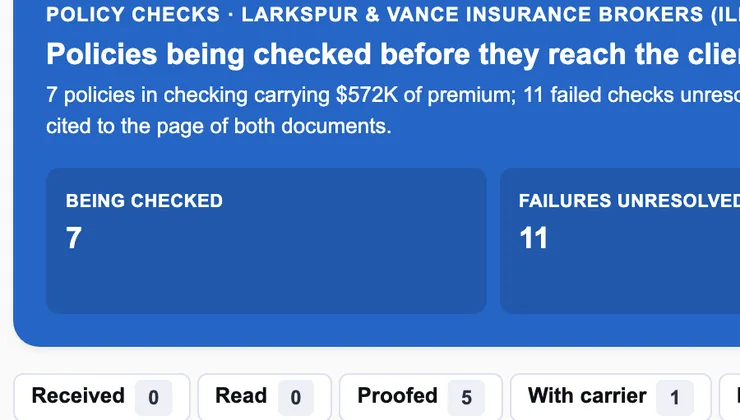
Where InsightProofing sits in the broker suite
Placement hands it the binder; Xtract reads the PDFs; Pulse knows the client; Advocate inherits the policy.
Read article
The first ninety days, and how to measure it
One team, one renewal month, every action at ask first.
Read article