
The renewal of an apartment owner’s property programme looks routine. The building limit is the same, the carrier is the same, the premium is up about fourteen percent and the client has agreed to it. And yet three things about the renewal would surprise the client after a storm, and one of them is not a proofing failure at all.
This post follows one illustrative property check in InsightProofing from the moment the issued policy arrives to the moment the client delivery summary is ready to sign. The insured, the carrier, the brokerage and every figure are invented Illustrative; the screens are the running product on that invented book.
| Insured | Bellwether Ridge Apartments, LP — a garden-style apartment community (illustrative) |
|---|---|
| Line | Property, renewal |
| Documents | Expiring policy, renewal quote, binder, issued policy — four pages each |
| Actors | Account manager (works the check), account executive (owns the client), practice leader (signs off referrals) |
| Agents involved | Document intake, coverage extraction, proofing checker, renewal comparison, forms, discrepancy drafter, client delivery writer, supervisor |
| What it finds | Four proofing failures (wind and hail deductible, valuation, total cost, premium arithmetic); three renewal changes that narrow cover, one of them the flood sublimit halved |
| Decisions and authority | Raising the failures with the carrier (account manager), sending each request (account manager, a dry run in this build), the delivery (account executive), sign-off on a large account (practice leader) |
| Outcome | Four tracked corrections with the carrier, one overdue; a delivery held until they are settled; a summary that names the flood change in plain words |
Two different questions: did they issue what we bound, and is it what the client had?
Policy checking asks two questions that are easy to blur. Proofing asks whether the carrier issued what was bound: the policy against the binder, the binder against the quote. Comparison asks what changed against the expiring policy: what the client is losing or gaining by renewing. A change can be perfectly proofed — quoted, bound and issued exactly as agreed — and still be the thing the client most needs to hear about.
what changed" --> Q["Renewal quote"] Q -- "proofing:
binder vs quote" --> B["Binder"] B -- "proofing:
policy vs binder" --> P["Issued policy
as endorsed"] EX -. "comparison" .-> B EX -. "comparison" .-> P style P fill:#ffe4ea,stroke:#e3405f
On Bellwether Ridge, the flood sublimit is the example of the second kind. It was $10,000,000 on the expiring and $5,000,000 on the renewal quote, the binder and the policy. Nothing failed proofing, because the carrier issued exactly what was bound. But the renewal comparison reads it as narrower, and a proofing control says a narrowing must be named in the delivery summary.
Step by step
The account manager adds the issued policy to the check. The expiring, the quote and the binder are already in the file; each is read page by page.
Four of four documents in the file. Nothing to ask the carrier or the client for.
Every document read into the property taxonomy: building and contents limits, business income, the all-other-perils and wind deductibles, flood and earthquake sublimits, valuation, coinsurance, premium, taxes, fees, commission. Each value keeps its page and the carrier’s own label.
51 of 56 checks match. Four fail: the wind and hail deductible (2% bound, 5% issued), valuation (replacement cost bound, actual cash value issued), total cost and the premium arithmetic. One needs review: the wind mitigation subjectivity is still outstanding. It prepares raising the four failures with the carrier.
Six changes: premium, taxes and total cost up about 14%; wind and hail deductible, flood sublimit and valuation narrower.
A high-severity failure is unresolved: delivery is blocked. Cover narrowed at renewal: the summary must say so. Total cost above $250,000? No — $196,220 — so no large-account referral.
Accepts the proofing checker’s prepared decision. Four correction requests are created, each citing the binder and the policy page.
Drafts the request to the carrier’s underwriter: one line of context, then each correction exactly as the engine found it.
Sends them, with a due date. Sending is capped at ask first, and in this build mail runs as a dry run until a brokerage connects its own.
The total-cost request passes its due date; it shows on the practice leader’s home as an overdue correction and the carrier-slow control warns.
Only once every failure is corrected or waived. Until then the Delivery zone says exactly what is in the way.
What the screens show

The comparison reads each change in the direction of the cover, not just the number. A higher deductible is narrower; a lower sublimit is narrower; actual cash value in place of replacement cost is narrower. The taxonomy records, field by field, which way is broader.
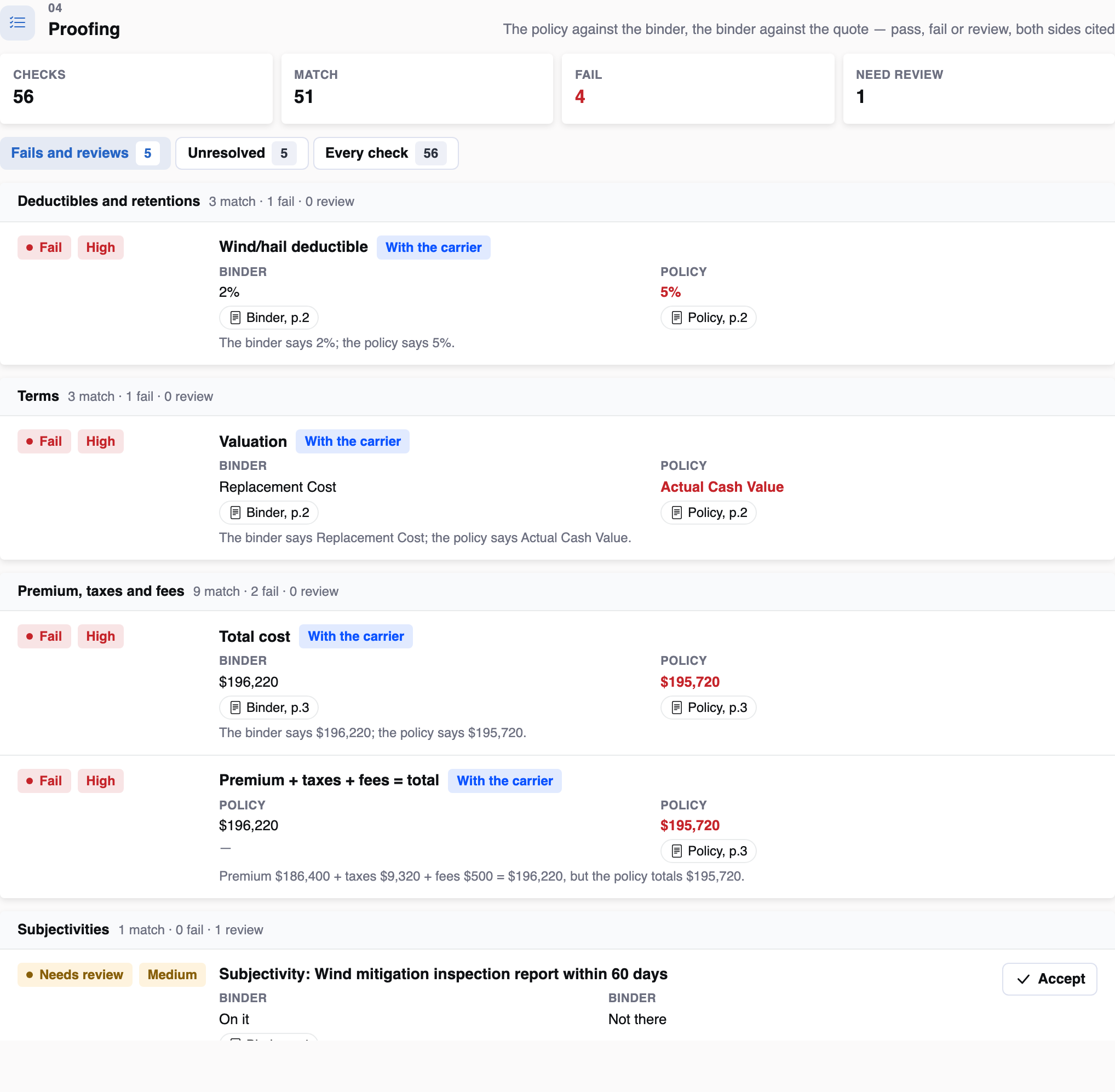
The proofing zone shows the binder’s value and the policy’s value side by side, with a chip for each page. Each failure here already says With the carrier, because the requests have been raised.

What the agents prepared, and what each rests on
| Agent | What it prepared | What it cites | Who decides |
|---|---|---|---|
| Proofing checker | Raise four failed checks with the carrier | Binder p.2 and p.3 against policy p.2 and p.3 | Account manager |
| Renewal comparison | Six changes, three narrower, with severity | Expiring, quote, binder and policy, p.2 and p.3 | — (findings) |
| Discrepancy drafter | The correction request, one item per failure | The four failed checks | Account manager sends |
| Supervisor | The controls that fired: block, heads-up, overdue | The check’s counts | Practice leader if referred |
| Client delivery writer | Not ready: what is still unresolved | Open failures and requests | Account executive |
The decision record
| Section | Hit | Outcome |
|---|---|---|
| Proofing control | A high-severity check failed and is unresolved | block |
| Proofing control | Cover narrowed at renewal (3 changes) | warn |
| Proofing control | A correction request is overdue at the carrier | warn |
| Proofing control | Total cost above $250,000 | pass |
| Prepared decision | Raise 4 failed checks — accepted by the account manager | proceed |
What the client has to hear
When the corrections are settled, the delivery writer drafts a paragraph for the client and a list of what changed. The control that fired guarantees the flood change is in it. The writer is held to the facts it was given: it may not add a number, a date or a form that is not among them, and an answer that does is thrown away in favour of the engine’s own wording.
Why this matters for E&O
A halved flood sublimit that the client agreed to is a business decision. A halved flood sublimit that the client was never told about is a broker’s problem. The difference is a sentence in the delivery summary — and a record that it was sent.
For the account team
One page shows what failed, what changed and what is with the carrier. The flood change cannot be forgotten: the summary will not be ready without it.
For broker IT
All six checks and six changes come from the engines over canonical fields; the model only drafts and explains. Every value has a page and a label.
For practice leadership
An overdue carrier request and a narrowing at renewal are both visible on the practice leader’s home, not in someone’s inbox.
Questions we get asked
Why isn’t the flood sublimit a proofing failure?
Because the carrier issued what was quoted and bound. Proofing is about whether the policy matches the deal; comparison is about what the deal changed. InsightProofing reports both, separately.
Who decides whether to accept actual cash value?
Not the agents. The account manager raises it with the carrier or, with a reason, waives it; waiving a high-severity failure refers the check to a practice leader.
Keep reading

A missing waiver and an exclusion nobody agreed
The binder lists the waiver the client's contracts require. The policy doesn't.
Read article
Where InsightProofing sits in the broker suite
Placement hands it the binder; Xtract reads the PDFs; Pulse knows the client; Advocate inherits the policy.
Read article
The first ninety days, and how to measure it
One team, one renewal month, every action at ask first.
Read article