
A logistics company’s customer contracts require a waiver of subrogation in their favour. The broker negotiated it; it is on the binder. It is not on the issued policy. And on page four of that policy there is a total pollution exclusion endorsement that appears nowhere on the binder or the quote.
Neither difference changes the declarations page. Both are found only by reading the forms schedule line by line against the binder’s. This post follows that check through InsightProofing. Everything in it — insured, carrier, forms schedule, amounts — is illustrative Illustrative.
| Insured | Ferncastle Logistics, LLC — a regional freight and warehousing business (illustrative) |
|---|---|
| Line | General liability, renewal |
| Documents | Expiring policy, quote, binder, issued policy |
| Agents involved | Coverage extraction, proofing checker, renewal comparison, forms and endorsements reviewer, supervisor, discrepancy drafter |
| What it finds | 55 checks: 50 match, 3 fail (the deductible, a waiver endorsement missing, a pollution exclusion added), 2 need review (the named insured’s legal suffix, an outstanding loss-run subjectivity); 6 renewal changes, 4 narrower |
| Decisions | Confirm one carrier label read by a close match; raise three failures with the carrier; a practice leader sign-off because a high-severity failure blocks delivery |
| Outcome | A correction request citing both documents for each failure, and a delivery that cannot happen until they are corrected or waived |
Why forms are where the surprises live
A forms schedule is a list of form numbers and editions: CG 00 01 04 13, CG 20 10 12 19,
CG 24 04 05 09. The coverage form is rarely the problem. The endorsements are: one that grants
something the client’s contracts require, one that takes something away. The forms and endorsements
reviewer matches forms by form number across documents, then compares the edition, so an edition change is
flagged for review and a renamed form is not seen as a new one.
form number"} P["Policy forms schedule
as amended by endorsements"] --> M M -->|"on both, same edition"| OK["Match"] M -->|"on both, edition differs"| E["Edition change
(review)"] M -->|"binder only"| D["Missing from policy
(fail, high)"] M -->|"policy only"| R{"Restrictive?
exclusion · limitation ·
sublimit · absolute"} R -->|"yes"| X["Added restriction
(fail, high)"] R -->|"no"| A["Added form
(review)"] style D fill:#ffe4ea,stroke:#e3405f style X fill:#ffe4ea,stroke:#e3405f
Step by step
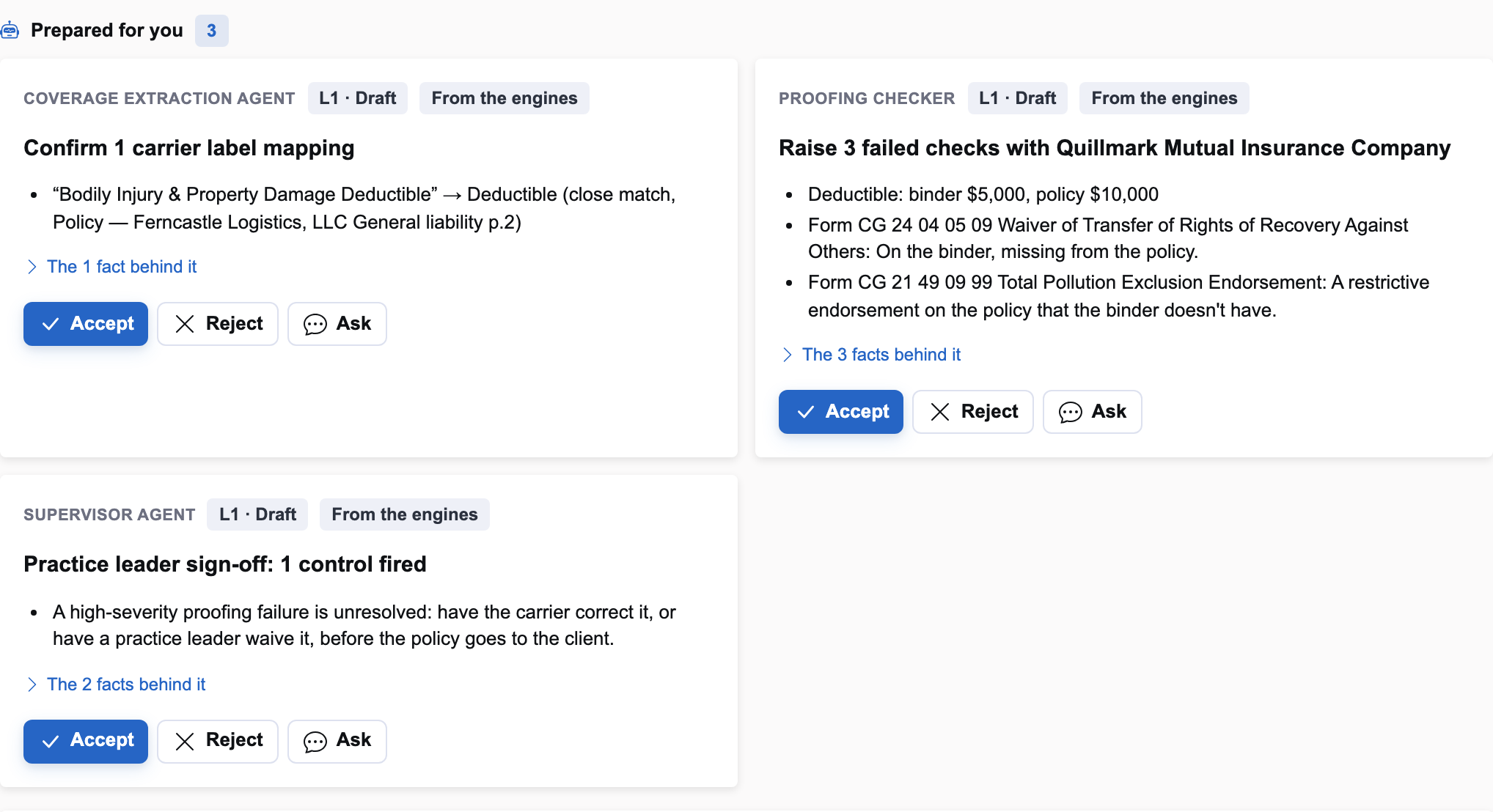
18 canonical GL fields read from each of four documents. One label on the policy — “Bodily Injury & Property Damage Deductible” — maps to deductible by a close match, so it is used and flagged.
The deductible fails: $5,000 on the binder, $10,000 on the policy. The waiver of subrogation CG 24 04 05 09 is on the binder and missing from the policy. CG 21 49 09 99 Total Pollution Exclusion is on the policy and not the binder.
Two items for a person’s eye: the named insured differs only in punctuation and the legal suffix (“LLC” against “, LLC”), and a binder subjectivity — five years of loss runs — is not shown as satisfied.
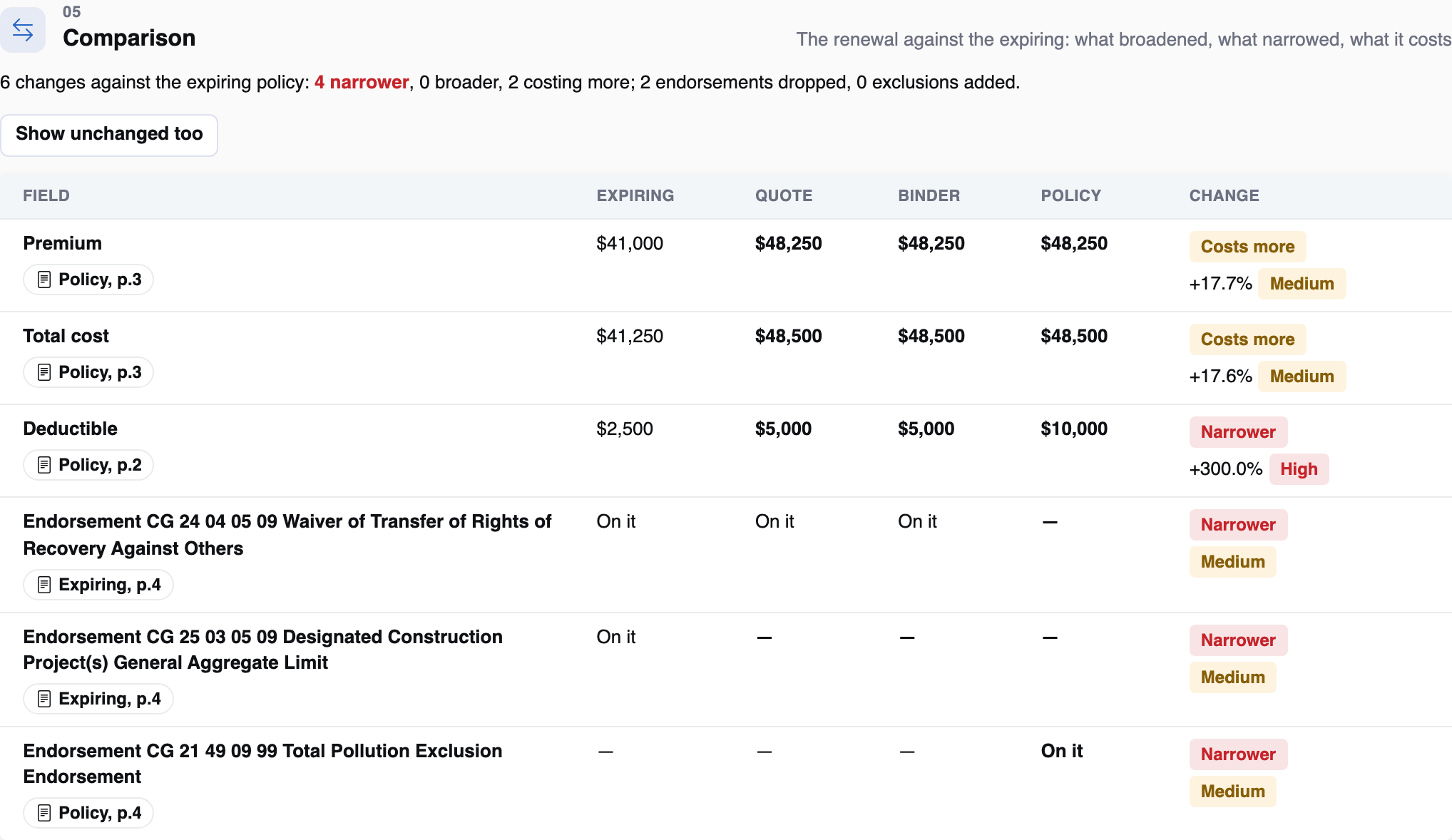
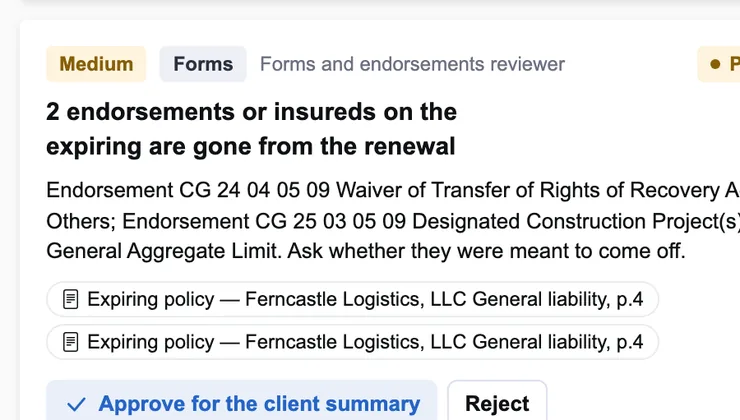
Against the expiring: premium $41,000 → $48,250 (+17.7%), deductible $2,500 → $10,000, two endorsements gone, one restrictive endorsement new. Four changes narrower.
Delivery blocked by the unresolved high-severity failures; a heads-up that the summary must name the narrowing. It prepares a practice leader sign-off.
Accepts the extraction agent’s mapping. The label is learned: next time it maps before any close match is tried.
Accepts the proofing checker’s prepared decision: three corrections created, each citing binder p.2 or p.4 and policy p.2 or p.4.
The discrepancy drafter’s request goes to the carrier’s underwriter with a due date (dry run in this build).
Accepts the named insured as the same legal entity, with a note.
When the carrier’s endorsement arrives it is read and overlaid on the policy; the checks re-run and the corrected items close.
What the screens show
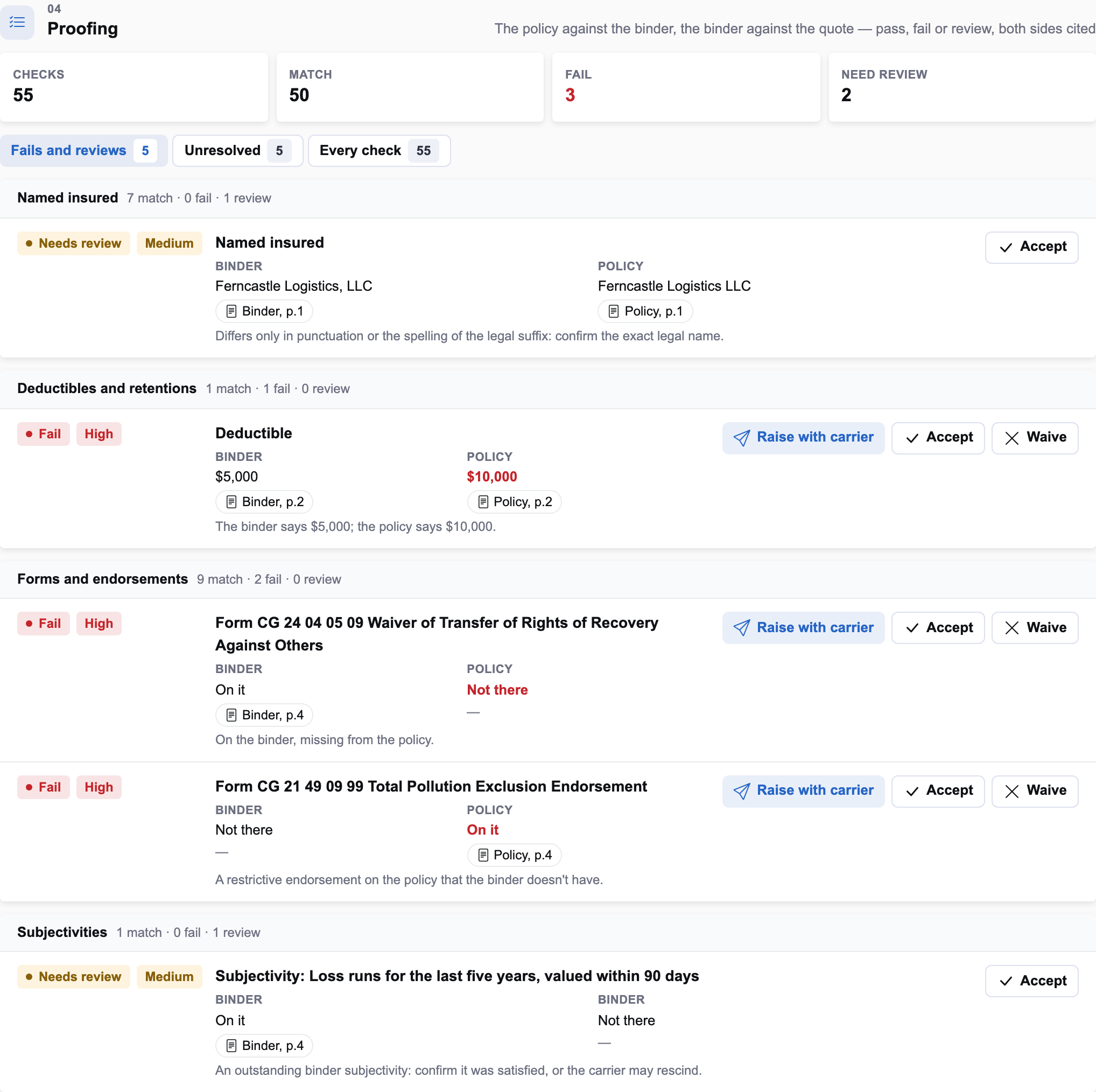
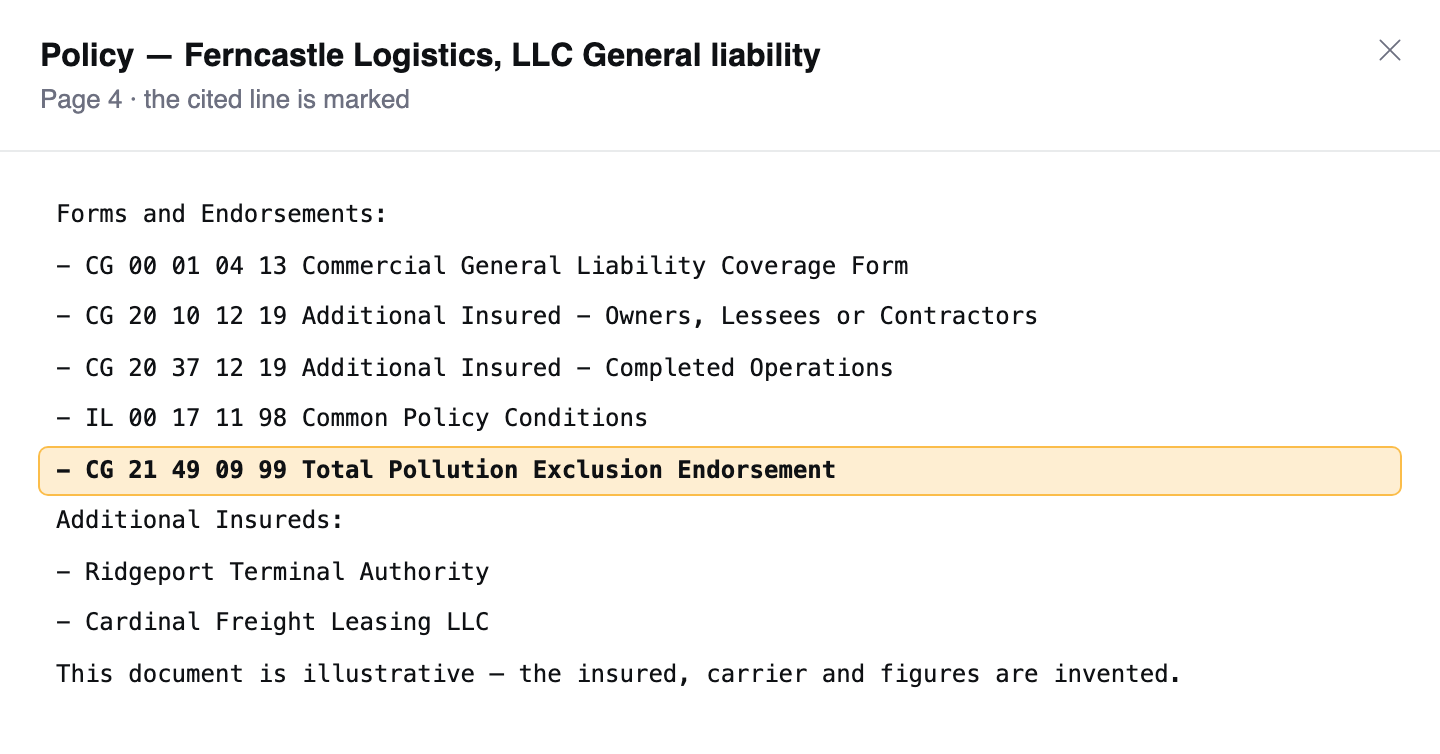
Every chip opens the page it cites with the line marked — here, page 4 of the policy and the pollution exclusion nobody agreed. The generated documents say on their own last line that they are illustrative.
What the agents prepared
| Agent | What it prepared | What it cites | Who decides |
|---|---|---|---|
| Coverage extraction | Confirm one carrier label mapping | Policy p.2: the deductible line | Account manager |
| Proofing checker | Raise 3 failed checks with the carrier | Binder p.2, p.4; policy p.2, p.4 | Account manager |
| Supervisor | Practice leader sign-off: 1 control fired | The unresolved high-severity count | Practice leader |
| Forms reviewer | Findings: 2 endorsements gone, 1 restrictive endorsement new | Expiring p.4, policy p.4 | — (findings) |
The decision record
| Section | Hit | Outcome |
|---|---|---|
| Proofing control | A high-severity check failed and is unresolved (3) | block |
| Proofing control | Cover narrowed at renewal (4 changes) | warn |
| Proofing control | Premium up more than 25% on the expiring (+17.7%) | pass |
| Prepared decision | Confirm 1 carrier label — accepted | proceed |
| Prepared decision | Raise 3 failed checks — accepted | proceed |
What the model may and may not do here
The forms reviewer may explain why a pollution exclusion matters to a freight business. It may not decide that the exclusion is acceptable, invent a form number or quote a premium for removing it. The engine’s match stands as the finding; the model’s sentence is shown only if every number in it is in the facts it was given.
For the account team
Three failures, each with both pages one click away, and the request already drafted. The two review items are quick human calls, not failures.
For broker IT
Forms are matched on the parsed form number, with the edition compared separately; the policy is read as amended by its endorsements before it is compared.
For practice leadership
Nothing reaches the client while a high-severity failure is open, unless a practice leader signs a waiver on the record.
Questions we get asked
What if the carrier says the exclusion was always intended?
Then the account team decides with the client. Waiving the failure is possible with a reason, and a waived high-severity failure refers the check to a practice leader before delivery.
Does a renamed form read as one dropped and one added?
No. Forms are keyed on the form number; the edition is compared separately and the title is not the key.
Keep reading
An additional insured, corrected before delivery
A convention partner named on the binder and nowhere on the policy.
Read article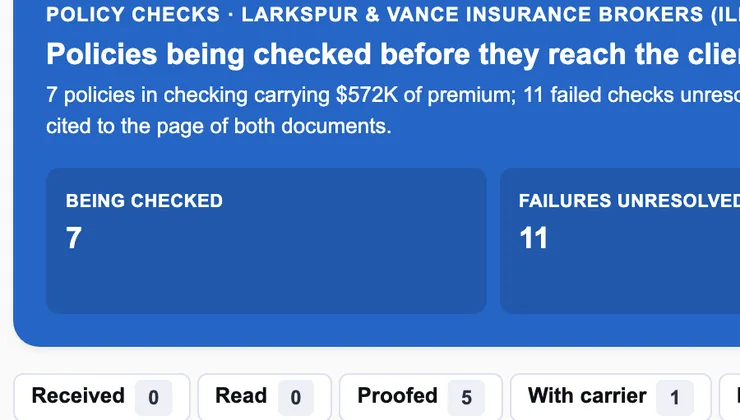
Where InsightProofing sits in the broker suite
Placement hands it the binder; Xtract reads the PDFs; Pulse knows the client; Advocate inherits the policy.
Read article
The first ninety days, and how to measure it
One team, one renewal month, every action at ask first.
Read article