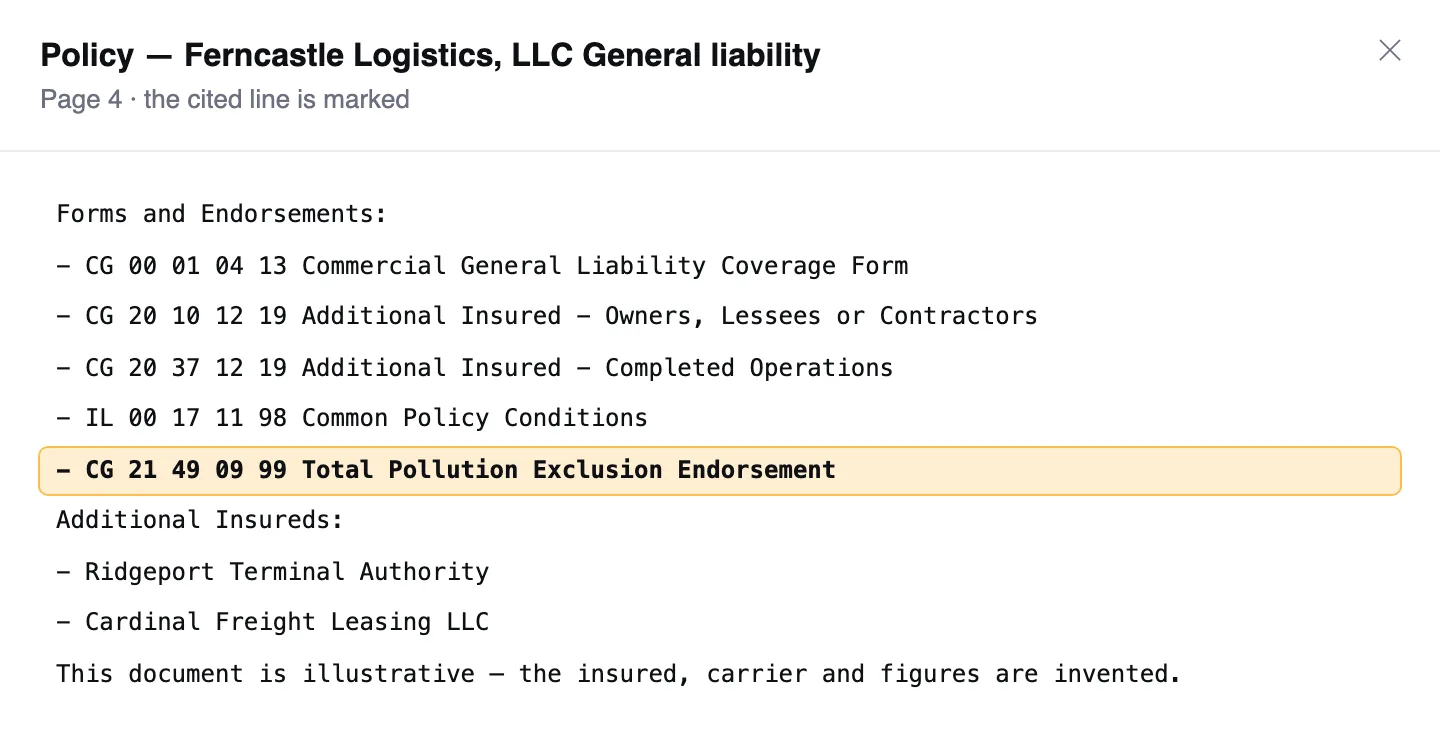
In a product whose whole job is to say whether two numbers are the same, a model that occasionally invents a number is not a quirk. It is disqualifying. So InsightProofing splits the work: engines compute every value, pass, fail and change; models explain and draft over those results; and an answer that carries a number not in its facts is thrown away.
Who does what
| Work | Done by | Why |
|---|---|---|
| Reading a value from a page | The extraction engine (or InsightXtract) | Each value keeps its page and line |
| Mapping a label | The taxonomy cascade; a person confirms close matches | Nothing silently guessed |
| Pass, fail, review | The proofing engine | Deterministic, repeatable, testable |
| Broader, narrower, costlier | The comparison engine | Direction is a property of the field |
| Explaining, prioritising, open questions | The agents, with the model | Language is what models are good at |
| Drafting the carrier request and client summary | The agents, with the model | Held to the facts they were given |
| Deciding what is sent | A person | Capped at ask first |
The grounding check
[F1] Binder deductible $5,000 (p.2)
[F2] Policy deductible $10,000 (p.2)"] --> M["Model answers in a fixed shape:
summary · findings with fact ids · open questions"] M --> V{"Valid shape?
Every number
in the facts?"} V -->|"yes"| K["Shown, with the facts behind it"] V -->|"no"| D["Discarded; the engine's own
finding stands, marked as such"] K --> U["Fact-id markers stripped
before display"] style D fill:#fff4e2,stroke:#e0851f
The prompts say it in plain words: use only the facts given; do not state any amount, date, percentage or count that is not written in them; never invent a clause, a form, a party or an insurer; when the facts don’t settle a question, say so and put it in the open questions. The code doesn’t rely on the prompt being obeyed — it checks.
Drafts work the same way. The correction request prompt lets the model rewrite the opening and keep every correction exactly as given; the client summary prompt lets it write one plain paragraph and add nothing. If the rewrite carries a number that isn’t in the facts, the engine’s draft is used instead.
What a person sees
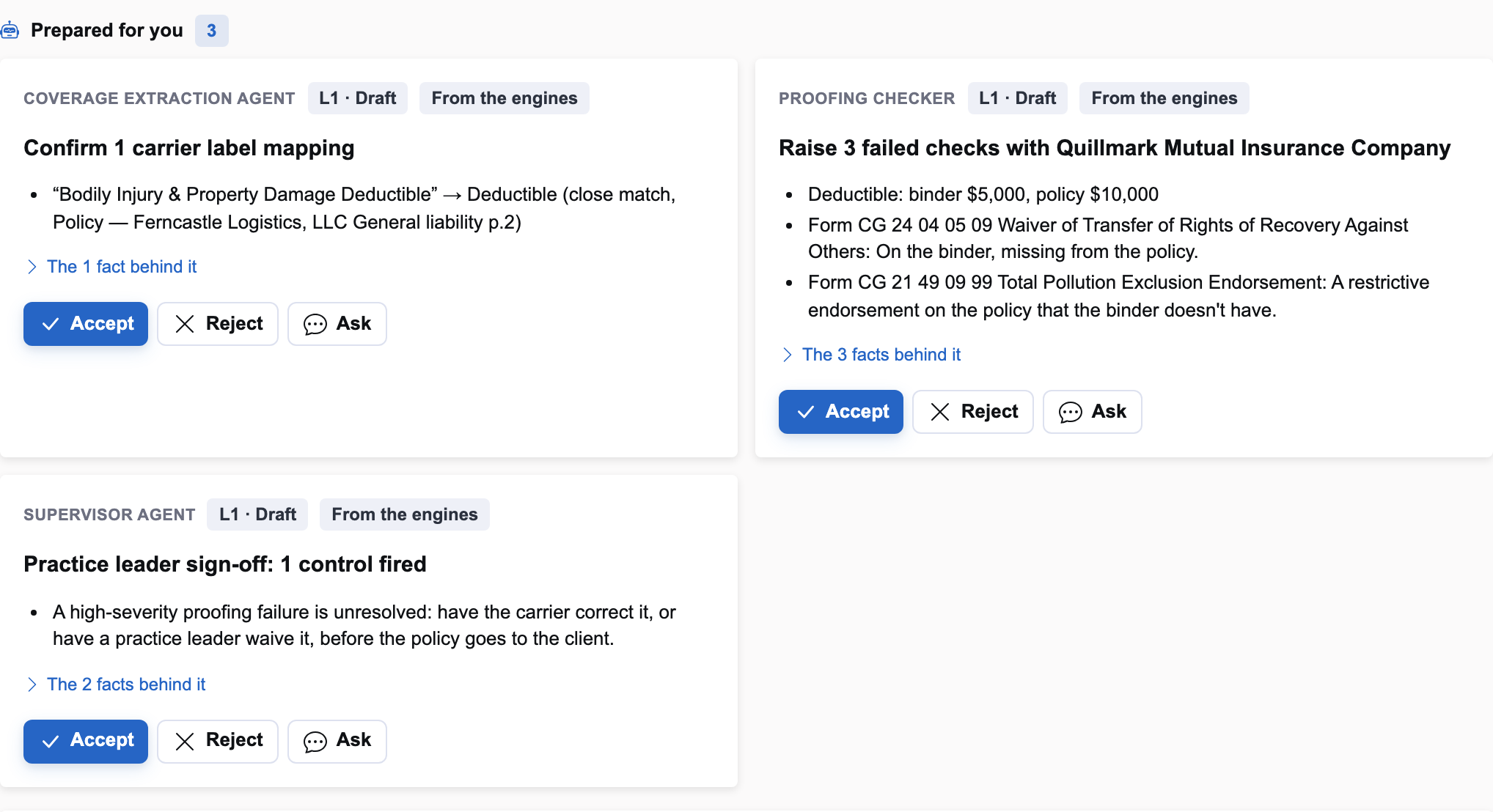
Every prepared decision says who wrote it: From the engines when the model was off or its answer was discarded, or the model’s reading with the facts behind it one click away. The run trace records the model, tokens, cost and time of every step. No fact-id marker ever reaches a screen.

For the account team
Trust the numbers because they came from the documents; use the model’s words to move faster.
For broker IT
A fixed answer schema, a validator, a numeric grounding check and an uncite pass before display.
For practice leadership
The model can be wrong about emphasis; it cannot be wrong about a limit.
Questions we get asked
What happens when the model is unavailable?
The engines’ findings stand and the screens say the model is off. Checking continues.
Is there a cost cap?
Each agent has a daily budget; above it, the fast model answers. Every step records its cost.
Keep reading

Product rationalization: one field, however the carrier words it
'Per Occ Limit', 'Each Occurrence', 'Each Occurrence Limit' — the same field, three ways.
Read article
A property renewal with a halved flood sublimit
Not a proofing failure — a renewal change the client must hear about in plain words.
Read article
A missing waiver and an exclusion nobody agreed
The binder lists the waiver the client's contracts require. The policy doesn't.
Read article