
A data-services company buys its first standalone cyber policy. The quote offered a $1,000,000 cyber-extortion sub-limit. The binder says $500,000. And the quote doesn’t call it a ransomware sublimit at all — it says “Cyber Extortion Sub-limit”, a label the coverage taxonomy had never seen.
This is a new-business check, so there is no expiring policy to compare against; the work is proofing the binder against the quote and the policy against the binder. It is also the clearest example of why proofing has to run on canonical fields. The company, carrier and figures are invented Illustrative.
| Insured | Quayside Data Systems, Inc. — a managed data-services company (illustrative) |
|---|---|
| Line | Cyber, new business |
| Documents | Quote, binder, issued policy (no expiring) |
| What it finds | 41 checks: 39 match; 1 fails (ransomware sublimit $1,000,000 quoted, $500,000 bound); 1 to review (an offline-backups subjectivity not shown as satisfied) |
| Rationalization | “Cyber Extortion Sub-limit” taught by a person as the ransomware sublimit; “Breach Response Costs” still unmapped |
| Agents involved | Coverage extraction, proofing checker, supervisor |
| Outcome | The label learned; the sublimit difference raised for the account team to settle with the carrier and client |
The label cascade, on a real example
Before anything can be proofed, every carrier label has to land on one canonical field. The extraction agent tries, in order: a label a person confirmed before; the taxonomy’s synonyms exactly; the synonyms with filler words like “limit”, “of” and “insurance” removed; a close string match at or above the taxonomy’s threshold, used but flagged for a person. Below that, the label is unmapped and listed.
Without that step the quote’s $1,000,000 would read as a field that exists only on the quote, and the binder’s $500,000 as a field that appeared from nowhere — two meaningless findings instead of one real one.
Step by step
Quote, binder and policy read into the cyber taxonomy: aggregate limit, ransomware, business-interruption and social-engineering sublimits, retention, waiting period in hours. One quote label is unknown; it prepares the mapping for a person to confirm.
Maps “Cyber Extortion Sub-limit” to the ransomware sublimit. It appears on the taxonomy page under Labels people taught, with who taught it and a Retire button for a lead.
Binder against quote: ransomware sublimit $1,000,000 on the quote, $500,000 on the binder — fail, high. The policy matches the binder.
“Offline backups confirmed in writing within 30 days of binding” is not marked received: needs review, because an unsatisfied subjectivity can let the carrier rescind.
Delivery blocked by the unresolved high-severity failure; a practice leader sign-off is prepared.
Decides with the client whether the lower sublimit was a negotiated trade or an error to raise with the carrier — either way, on the record.
What the screens show

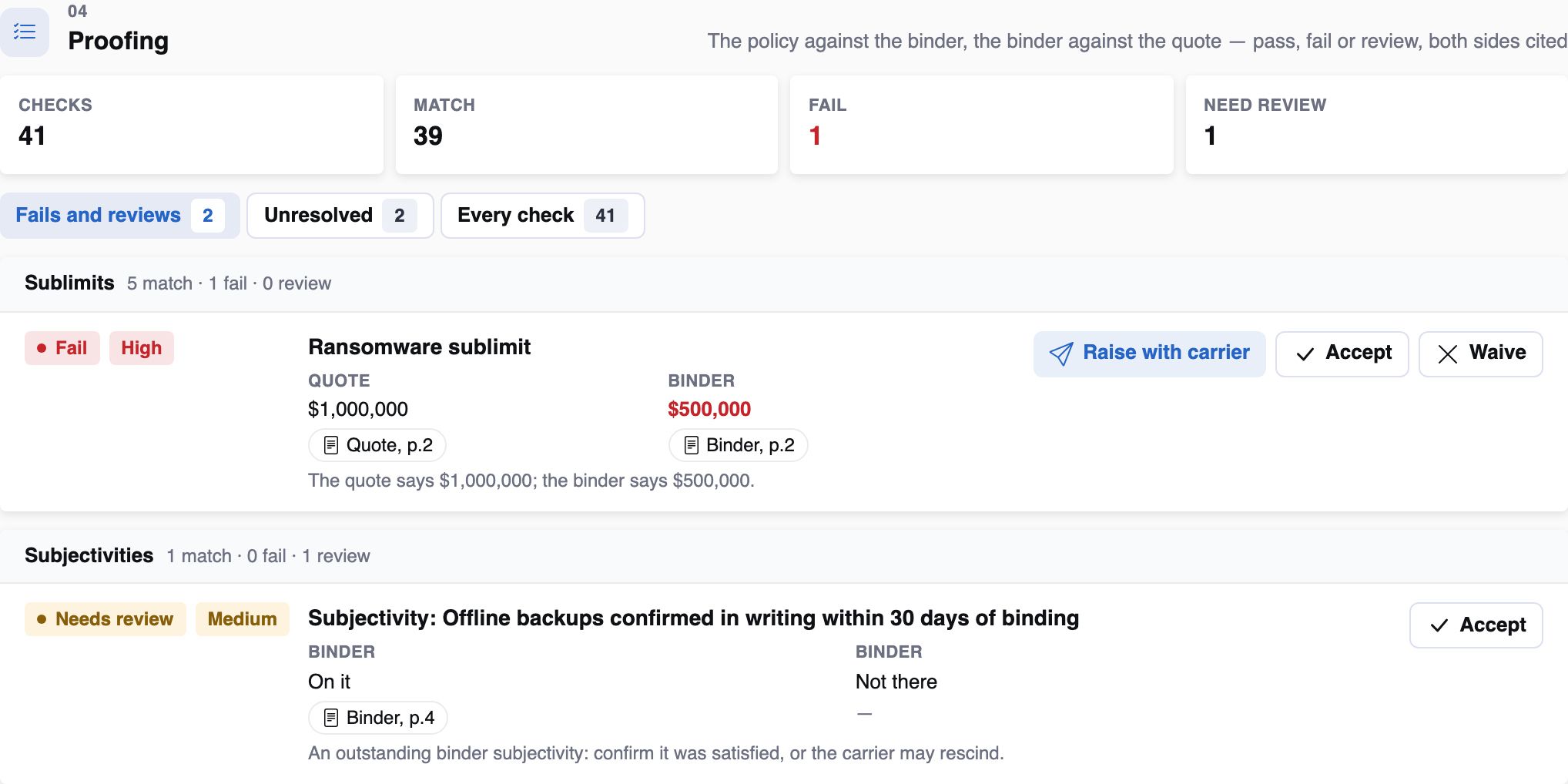

What the agents prepared
| Agent | What it prepared | What it cites | Who decides |
|---|---|---|---|
| Coverage extraction | Confirm a carrier label onto a canonical field | Quote p.2 | Account manager |
| Proofing checker | Raise 1 failed check with the carrier | Quote p.2, binder p.2 | Account manager |
| Supervisor | Practice leader sign-off | The unresolved high-severity failure | Practice leader |
| Section | Hit | Outcome |
|---|---|---|
| Prepared decision | Confirm label mapping — accepted | proceed |
| Proofing control | A high-severity check failed and is unresolved | block |
| Subjectivity | Offline backups confirmation outstanding | warn |
For the account team
Teach a label once and the next cyber quote from that carrier reads cleanly.
For broker IT
Learned mappings are stored and tried first; close matches are used but flagged; nothing is silently guessed.
For practice leadership
A new line of business with unfamiliar wording doesn’t mean unchecked policies — the unknown labels are listed, not dropped.
Questions we get asked
Who may retire a learned label?
A lead, from the taxonomy page. Retiring it means the cascade no longer uses it.
Is a close match ever used without a person?
It is used so the check can run, and it is flagged on the field and prepared as a mapping to confirm.
Keep reading

When premium + taxes + fees doesn't equal the total
Every field matches the binder except the one that adds them up.
Read article
Where InsightProofing sits in the broker suite
Placement hands it the binder; Xtract reads the PDFs; Pulse knows the client; Advocate inherits the policy.
Read article
The first ninety days, and how to measure it
One team, one renewal month, every action at ask first.
Read article