
Field-by-field proofing answers “does this value match the binder?” Some errors don’t live in one value. A policy can carry the right premium, the right taxes and the right fees and still state a total that isn’t their sum. A renewal can start a day after the expiring ended. A tower can have every layer right and still leave a gap between two of them.
InsightProofing runs a small set of derived checks on every issued policy for exactly these cases. This post walks through them on an illustrative property policy whose total is $500 short of its own arithmetic Illustrative.
| Insured | Bellwether Ridge Apartments, LP (illustrative) |
|---|---|
| Line | Property, renewal |
| Policy page 3 | Premium $186,400 · taxes $9,320 · fees $500 · total cost $195,720 |
| The arithmetic | $186,400 + $9,320 + $500 = $196,220, which is also the binder’s total |
| Checks that fail | Total cost against the binder; premium + taxes + fees = total |
| Outcome | Two linked failures raised in one correction request round with the carrier |
The derived checks
| Check | What it tests | On failure |
|---|---|---|
| Policy term | Effective to expiration is 365 or 366 days. | Needs review, medium |
| Renewal continuity | The renewal starts the day the expiring ends — no gap, no overlap. | Fail, high |
| Premium arithmetic | Premium + taxes + fees equals the stated total. | Fail, high |
| Policy number | The issued policy has one. | Needs review, low |
| Tower adjacency | Each layer attaches where the one below ends (umbrella and excess). | Fail, high |
| Schedule of underlying | Each underlying line, carrier and limit matches the binder. | Fail, high |
premium · taxes · fees · total"] --> S["Sum = $196,220"] S --> C{"Sum = stated
total $195,720?"} C -->|"no"| F["Fail · high
'Premium + taxes + fees = total'"] B["Binder total $196,220"] --> T{"Policy total =
binder total?"} P --> T T -->|"no"| F2["Fail · high
'Total cost'"] F --> R["One correction round
with the carrier"] F2 --> R style F fill:#ffe4ea,stroke:#e3405f style F2 fill:#ffe4ea,stroke:#e3405f
Step by step
Premium, taxes, fees, total and commission read from page 3 of each document, under whatever label each carrier uses — “Total Due”, “Total Payable”, “Grand Total” are all total_cost.
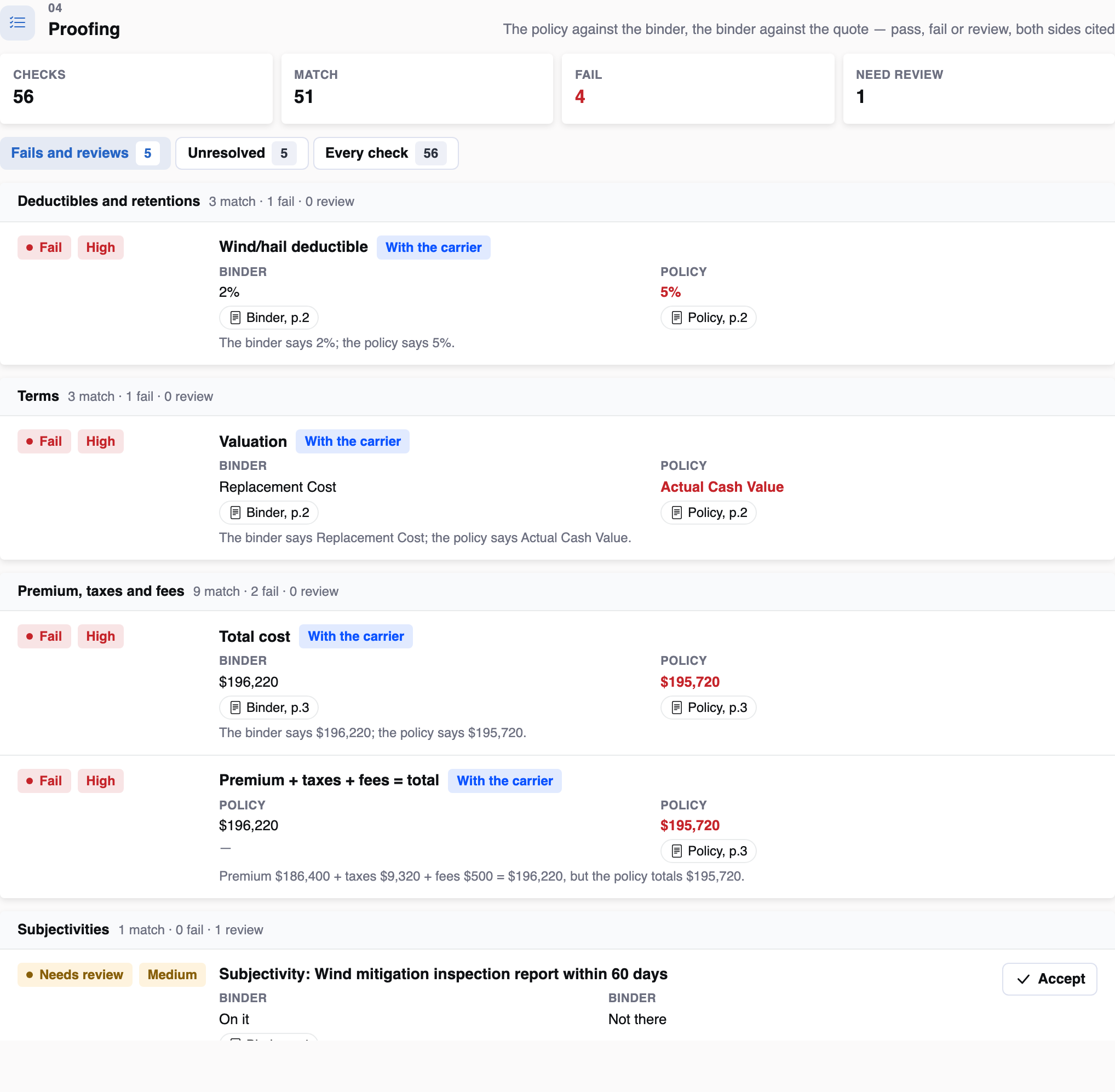
Premium, taxes and fees match the binder. Total cost does not: $196,220 bound, $195,720 issued.
Premium + taxes + fees = $196,220 against a stated $195,720: the policy disagrees with itself. The note on the check spells out the sum.
Both go to the carrier in the same round as the property failures, each citing policy p.3.
The total-cost request passes its due date and shows as an overdue correction on the practice leader’s home.
What the screen shows
Why arithmetic belongs in the engine, not the model
A language model can be asked to add four numbers, and will usually get it right. “Usually” is not a standard for an invoice the client will pay. The sum is computed in code and stated in the check’s note; the model may explain why it matters, and its answer is discarded if it carries a number the facts don’t hold.
| Section | Hit | Outcome |
|---|---|---|
| Proofing | Total cost: binder $196,220, policy $195,720 | block |
| Proofing | Premium + taxes + fees = total | block |
| Proofing control | A correction request is overdue at the carrier | warn |
For the account team
A $500 discrepancy in a $196,000 invoice is easy to miss by eye and impossible to miss here.
For broker IT
Derived checks are pure functions over canonical fields, run on every issued policy.
For practice leadership
Billing disputes with clients start with numbers that don’t add up. This removes a class of them before delivery.
Questions we get asked
Which document wins when the policy disagrees with itself?
Neither: it is a failure for the carrier to correct, cited to the page, and a person decides what to ask for.
Keep reading

A clean commercial auto renewal, delivered
48 of 48 checks match. Three vehicles added. The summary writes itself — almost.
Read article
Where InsightProofing sits in the broker suite
Placement hands it the binder; Xtract reads the PDFs; Pulse knows the client; Advocate inherits the policy.
Read article
The first ninety days, and how to measure it
One team, one renewal month, every action at ask first.
Read article